

Hydraulic Breaker Attachments: What You Need to Know Before Choosing One
TL;DR: A hydraulic breaker attachment turns an excavator into a rock and concrete demolition tool by converting hydraulic flow into repeated striking force. Getting the right fit means matching breaker weight class to carrier size and confirming the excavator’s hydraulic flow and pressure meet the breaker’s specs. The wrong match causes poor production, faster wear, and damage to the carrier.
What Is a Hydraulic Breaker Attachment?
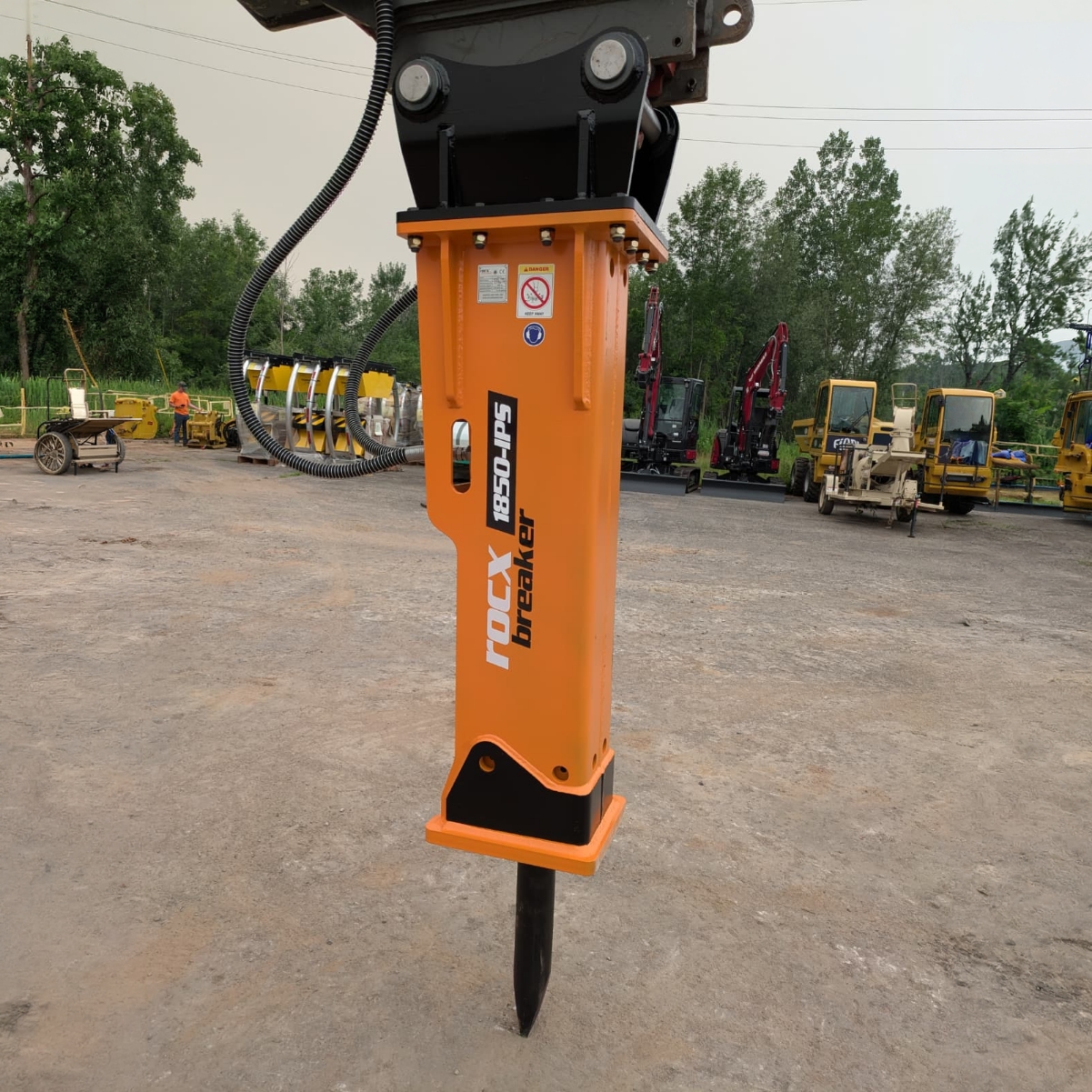
A hydraulic breaker mounts to an excavator, mini excavator, or skid steer in place of a bucket, using the carrier’s hydraulic system to drive a piston that strikes a tool bit at high frequency. RocxBreaker builds its breaker line across this range, from compact models for mini excavators up to heavy IPS-series breakers for large carriers.
- Piston-driven design delivers repeated impact energy through a tool bit
- Powered by the carrier’s existing hydraulic flow, no separate power source needed
- Mounts to excavators, mini excavators, and skid steers depending on breaker size
- Used for demolition, rock removal, trenching, and site clearing
How Do You Match a Breaker to Your Carrier?
Carrier weight class is the starting point for breaker selection. A breaker sized too large for the carrier can stress the boom and hydraulics, and a breaker sized too small will underperform and wear out faster from being overworked.
- Compact excavators (0.6 to 4.5 tons): 250IP, 350IP, and 450IP/450PSL cover this range
- Mid-size excavators (4 to 12 tons): 750IP and 950IP breakers handle general demolition and rock work at this class
- Large excavators (11 to 26 tons): 1850IPS and 2650IPS step up to heavier demolition and rock removal
- Quarry-class excavators (25 to 48 tons): 3050IPS through 4650IPS cover the top of the RocxBreaker lineup for sustained heavy-duty work
Checking the carrier’s operating weight, hydraulic flow rate, and pressure rating against the breaker’s spec sheet prevents mismatches before the attachment ever reaches the jobsite. RocxBreaker’s spec sheets list this range for every model, making it a quick check against the carrier’s own documentation.
What Hydraulic Specs Actually Matter?
A breaker attachment only performs to spec if the carrier’s hydraulic system supplies what the breaker needs.
- Flow rate (GPM): required flow ranges from about 4 to 8 GPM on the compact 250IP up to 51 to 69 GPM on the largest 4650IPS, so flow must match the specific model, not just the carrier’s general size class
- Operating pressure (PSI): ranges from roughly 1,280 to 1,707 psi on the smallest models up to 2,276 to 2,560 psi on the largest IPS-series breakers
- Back pressure: excess back pressure in the return line reduces impact energy
- Auxiliary hydraulic circuit: some carriers need a plumbing kit added before a breaker can be run at all
Confirming these specs against the carrier’s documentation, rather than the excavator’s general size class alone, is the more reliable way to avoid a mismatch.
How Do You Maintain a Hydraulic Breaker Attachment?
Breakers see repeated impact and heat cycling, so maintenance intervals are tighter than most other attachments.
- Grease the tool bushing at the start of every shift
- Check the tool retainer pins and bushings for wear on a regular schedule
- Avoid dry firing, running the breaker without the tool bit in contact with material, since it transfers impact energy straight into the tool itself
What Applications Is a Hydraulic Breaker Attachment Used For?
Breakers cover a wide range of work beyond straightforward demolition.
- Demolition: foundations, slabs, and structural concrete removal
- Rock removal: rock ledges, boulders, and hardpan that block excavation
- Trenching: utility and pipeline trenches through rock or frost-hardened ground
- Site prep: clearing old pavement, curb, and debris ahead of new construction
Frequently Asked Questions
What size hydraulic breaker attachment do I need for my excavator?
It depends on the excavator’s operating weight: 0.6 to 4.5 tons runs the 250IP, 350IP, or 450IP/450PSL, 4 to 12 tons runs the 750IP or 950IP, 11 to 26 tons runs the 1850IPS or 2650IPS, and up to 48 tons runs the 3050IPS through 4650IPS.
Do I need to add a hydraulic plumbing kit to run a breaker?
Some carriers, especially skid steers and smaller excavators without a factory auxiliary circuit, need a plumbing kit added before a breaker can be connected. Checking the carrier’s hydraulic setup ahead of time avoids a delay once the breaker arrives.
Can a hydraulic breaker attachment damage my excavator if it's the wrong size?
Yes. An oversized breaker strains the boom, arm, and hydraulic system, while an undersized one wears out faster from working harder than its rated capacity. Matching breaker weight class and hydraulic specs to the carrier protects both.
Not sure which hydraulic breaker attachment fits your excavator?
Browse the full lineup at rocxbreaker.com or reach out to our team for a recommendation based on your machine and application.
Call us: +1 877-617-7368