

Skid Steer Hydraulic Breakers: How to Choose the Right Attachment
TL;DR: A skid steer hydraulic breaker mounts to the machine’s quick-attach system and runs off its auxiliary hydraulic circuit to deliver demolition and rock-breaking power. Choosing the right one comes down to matching the breaker’s required flow to the skid steer’s standard or high-flow hydraulic output, and selecting a model from RocxBreaker’s compact lineup rated for skid steer duty.
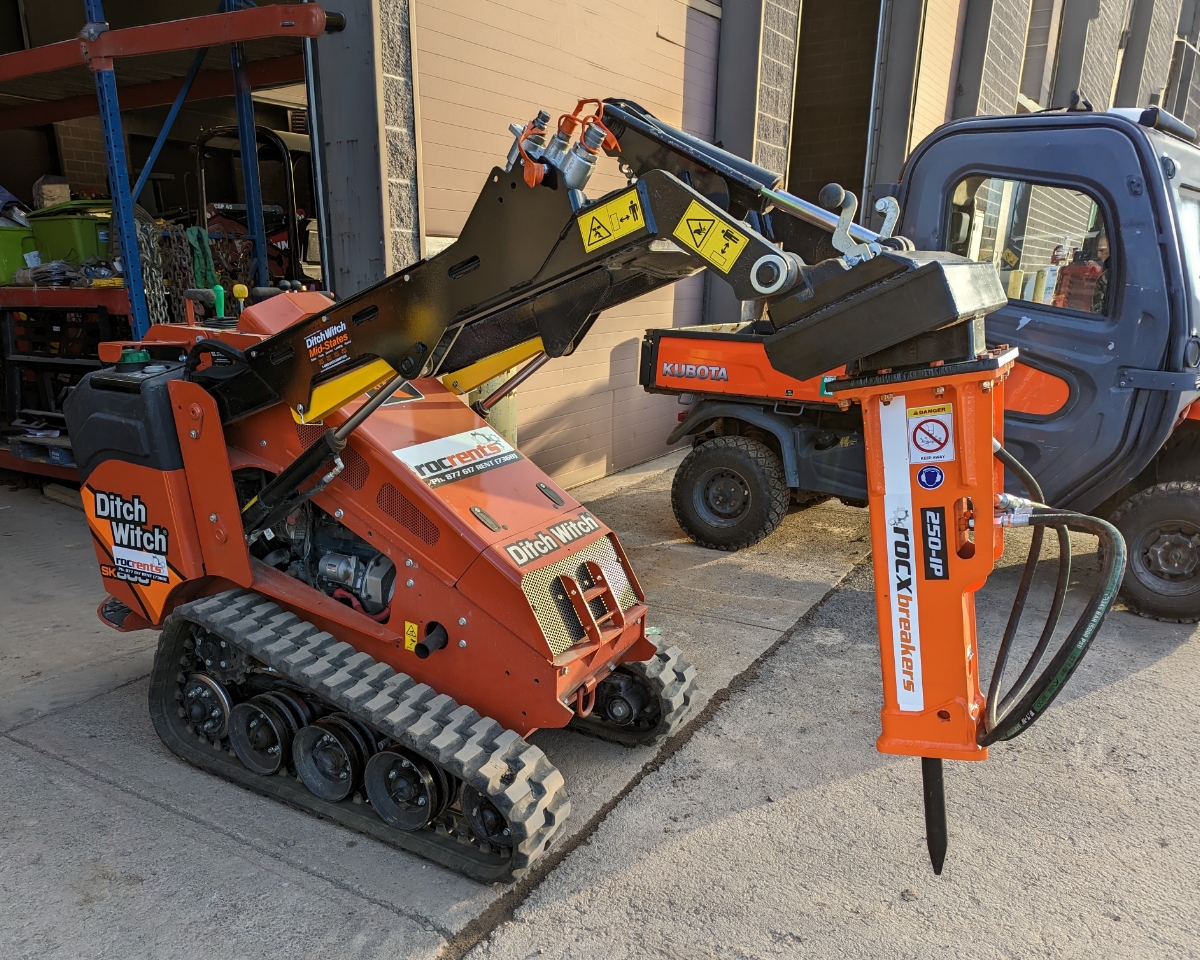
What Is a Skid Steer Hydraulic Breaker?
A skid steer hydraulic breaker is an attachment that connects to the skid steer’s quick-attach plate and hydraulic lines in place of a bucket. It uses the skid steer’s auxiliary hydraulic flow to drive a piston that strikes a tool bit at high frequency, breaking apart concrete, rock, and other hard material. RocxBreaker’s compact breaker models are engineered for use on skid steers as well as mini and full-size excavators.
- Runs off the skid steer’s auxiliary hydraulic circuit, no separate power source needed
- Connects through the standard quick-attach plate like other skid steer attachments
- Delivers repeated impact energy through a tool bit at the base of the breaker
- Gives a skid steer demolition and rock-breaking capability without a dedicated excavator
How Does Hydraulic Flow Affect Breaker Selection?
Skid steers are rated by hydraulic flow rather than the operating weight classes used for excavators, and that flow output determines which breaker will actually run at full power.
- Standard-flow skid steers: typically supply auxiliary flow in the mid-to-high teens to low 20s GPM range
- High-flow skid steers: supply a higher auxiliary flow, often in the high 20s GPM and above
- A breaker that requires more flow than the skid steer supplies will cycle slowly and underperform
- A breaker that requires less flow than the skid steer supplies will not be damaged, but its full impact energy rating will not be reached either
Checking the skid steer’s rated auxiliary flow against the breaker’s required flow range is the starting point for any skid steer breaker selection.
Which RocxBreaker Models Fit a Skid Steer?
RocxBreaker’s compact IP-series models are built for the lower flow and pressure output typical of skid steers.
- 250IP: requires 4 to 8 GPM at 1,280 to 1,707 psi
- 350IP: requires 5 to 10.5 GPM at 1,280 to 1,707 psi
- 450IP / 450PSL: requires 6.5 to 13 GPM at 1,280 to 1,707 psi
- 750IP: requires 10.5 to 18.5 GPM at 1,565 to 1,991 psi
These four models cover the flow range most standard-flow and high-flow skid steers supply. Larger RocxBreaker models are rated for excavators above skid steer weight and flow classes.
What Applications Is a Skid Steer Hydraulic Breaker Used For?
A skid steer breaker covers many of the same applications as a larger excavator-mounted breaker, at a scale that fits tighter job sites.
- Demolition: foundations, slabs, and structural concrete removal
- Rock removal: rock ledges, boulders, and hardpan that block excavation
- Trenching: utility and pipework installations
- Site prep: clearing old pavement, curb, and debris ahead of new construction
Frequently Asked Questions
What size skid steer hydraulic breaker do I need?
It depends on your skid steer’s rated auxiliary flow. Standard-flow machines typically pair well with the 250IP, 350IP, or 450IP/450PSL, while high-flow machines can run the 750IP.
Can any skid steer run a hydraulic breaker?
Only skid steers with an auxiliary hydraulic circuit can run a breaker. Most skid steers built for attachment work already have one, but it is worth confirming before ordering.
Is a skid steer breaker as powerful as an excavator breaker?
Not typically. Skid steers supply less hydraulic flow and pressure than large excavators, so skid steer-compatible breakers are built in RocxBreaker’s lower impact energy classes rather than the heavier IPS-series models.
Not sure which skid steer hydraulic breaker fits your machine?
Browse the full lineup at rocxbreaker.com or reach out to our team for a recommendation based on your machine and application.
Call us: +1 877-617-7368