

How Do You Choose the Right Hydraulic Breaker for Concrete Demolition?
TL;DR: The right hydraulic breaker for concrete demolition comes down to matching breaker weight and impact energy to your excavator’s class, then adjusting for slab thickness, rebar, and how enclosed the work area is. Light and mid-size breakers (250IP through 750IPH) handle driveways, sidewalks, and foundation walls on mini excavators. Larger breakers (950IP through 4650IPS) are built for structural demolition, footings, and heavy reinforced concrete on standard and large excavators.
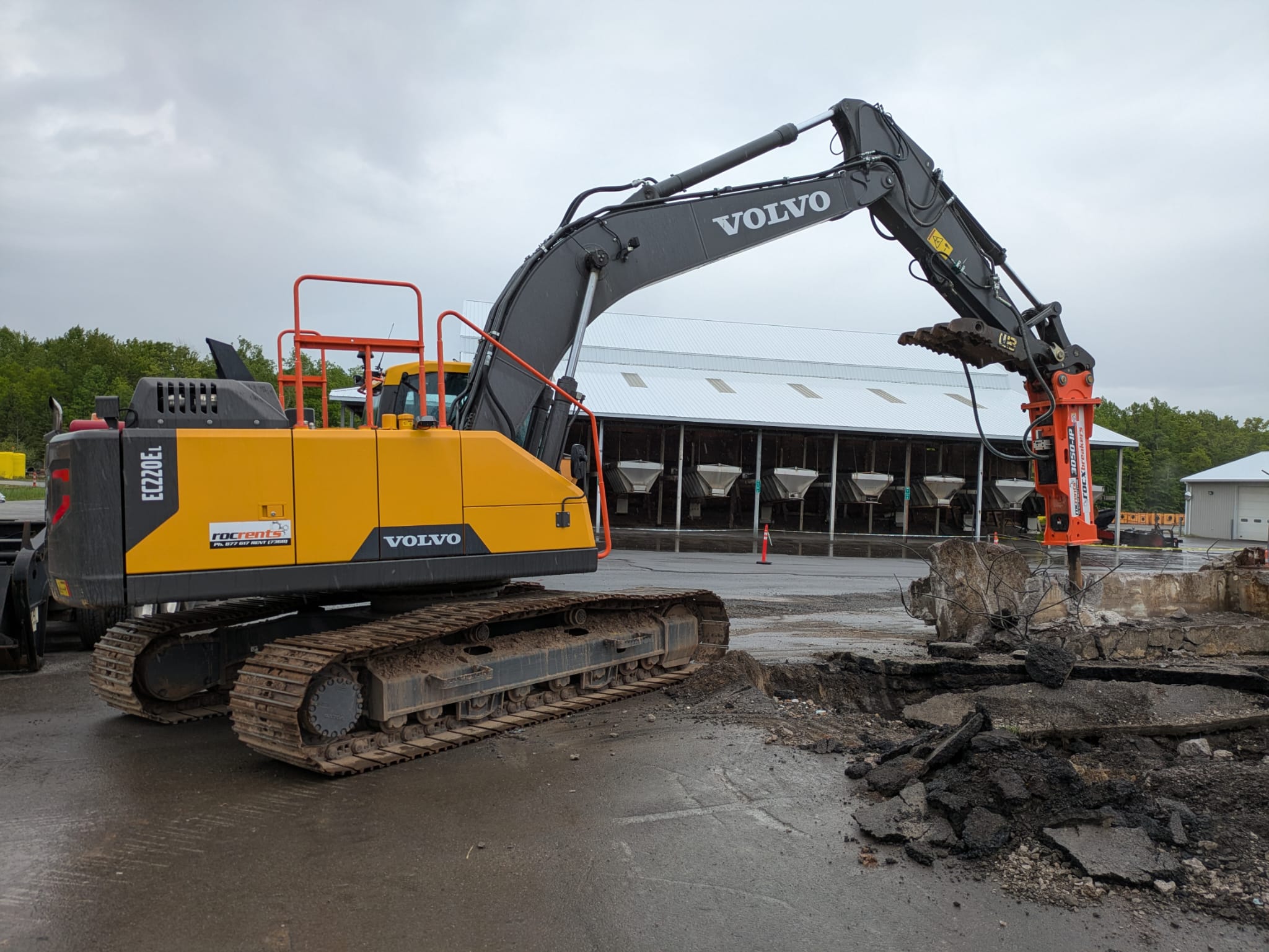
What Makes Concrete Demolition Different From Rock Breaking?
Concrete is a manufactured material, so it behaves more predictably than rock. But reinforcement changes the job.
Rebar and wire mesh don’t shatter the way plain concrete does. A breaker has to fracture the concrete around the steel, then the steel needs to be cut or pulled separately.
- Slab thickness matters. A 4-inch sidewalk breaks apart differently than an 8-inch foundation wall or a 12-inch footing.
- Reinforcement adds resistance. Rebar-heavy structural concrete needs more sustained impact energy than plain slab work.
- Confined spaces limit equipment size. Basement demolition or tight urban lots often rule out larger machines regardless of how tough the concrete is.
How Should Excavator Size Guide Your Breaker Choice?
A hydraulic breaker has to match the hydraulic flow and carrier weight of the excavator running it. Oversized breakers stress the boom and undercarriage. Undersized breakers waste cycle time.
Mini Excavators (Up to 8 Tons)
Mini excavators handle most residential and light commercial concrete work: driveways, patios, curbs, and small foundation sections.
- 250IP and 350IP (0.6 to 3 ton carriers): light slab and sidewalk demolition
- 450IP and 450PSL (2.5 to 4.5 ton carriers): driveways, curbs, and small foundation walls
- 750IP and 750IPH (4 to 8 ton carriers): mid-weight residential and light commercial slabs
Standard and Large Excavators (8 Tons and Above)
Larger excavators bring the hydraulic flow needed for structural demolition, footings, and heavily reinforced concrete.
- 950IP (8 to 12 ton carriers): heavier foundation work and general construction
- 1850IPS and 2650IPS (11 to 26 ton carriers): foundation walls, footings, and commercial slab-on-grade
- 3050IPS, 3650IPS, and 4050IPS (25 to 36 ton carriers): structural demolition and heavy reinforced concrete
- 4650IPS (40 to 48 ton carriers): large-scale commercial and industrial demolition
What Role Does Impact Energy Play in Breaking Concrete?
Impact energy, not just breaker weight, determines how cleanly a breaker fractures concrete. A breaker matched to the job cycles through material faster and puts less strain on the carrier.
- Too small: the breaker stalls on thick slabs or heavily reinforced sections, driving up cycle time and wear.
- Too large: the excavator can’t fully support the breaker’s energy, which shortens the life of both the tool and the machine.
Matching breaker class to excavator weight class is the fastest way to get this right before looking at any other spec.
Does Rebar Change Which Breaker You Need?
Heavily reinforced concrete needs sustained impact energy to fracture the material around the steel, not just a single hard strike.
- Light reinforcement (mesh, thin rebar): mid-weight breakers like the 750IP or 950IP series handle this without issue.
- Heavy reinforcement (structural rebar grids): step up to IPS-series breakers, which are built for sustained, heavier-duty cycles.
After the concrete fractures, exposed rebar still needs to be cut. A breaker clears the concrete; it doesn’t replace a rebar shear or cutter.
What About Noise, Vibration, and Working in Tight or Occupied Areas?
Demolition near occupied buildings, in residential neighborhoods, or on interior floors raises different concerns than open-site work.
- Smaller breakers on mini excavators generate less noise and vibration, which helps on residential and occupied commercial sites.
- Larger breakers move more material per hour but transmit more vibration into surrounding structures, which matters near foundations you’re not demolishing.
On sensitive sites, choosing a breaker one size down and accepting a slower cycle time is often the better tradeoff.
How Do You Keep a Breaker Running Through a Demolition Job?
Concrete demolition puts more continuous strain on a breaker than intermittent rock work, so maintenance intervals matter.
- Grease the tool bushing at the start of every shift, more often in high-cycle demolition work
- Check tool retainer pins and bushings for wear, since concrete debris accelerates wear faster than dirt or rock
- Inspect hydraulic hose connections regularly on jobs with high cycle counts
Match tool tip style (moil point, chisel, or blunt) to the concrete type and reinforcement level
Frequently Asked Questions
Can one breaker handle both demolition and general excavation work?
Yes, within its rated size class. A breaker sized for structural demolition will also handle general rock and trenching work on the same excavator, but a breaker sized only for light rock work may not hold up to sustained concrete demolition.
Do I need a different tool tip for concrete versus rock?
Generally, a moil point or chisel tip works well for concrete, while a blunt tip is better suited to layered rock. Ask your RocxBreaker contact which tip fits your specific job before starting.
What size breaker do I need for a residential foundation?
Most residential foundation work falls in the 450 through 950IP series range, depending on wall thickness and whether the concrete is reinforced. A quick call with our team can confirm the right fit for your excavator.
Not sure which model fits your excavator and your site?
Browse the full lineup at rocxbreaker.com or reach out to our team for a recommendation based on your machine and application.
Call us: +1 877-617-7368